
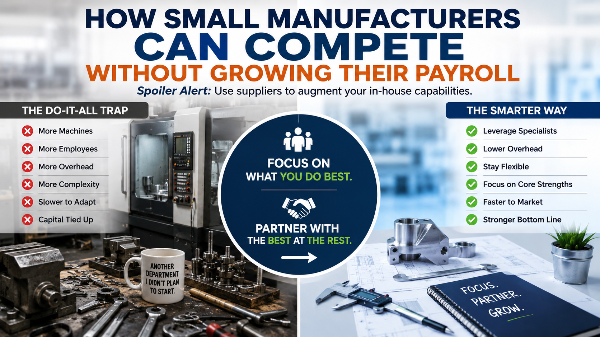
At some point, nearly every growing manufacturer has the same conversation.
"We should probably start doing that ourselves."
Maybe it's machining. Maybe injection molding. Maybe anodizing, laser engraving, packaging, fulfillment, or any number of other manufacturing processes. The thinking is understandable. If we own the equipment, we'll control the quality, save money, and stop depending on someone else.
Sometimes that's exactly the right decision.
A lot of times, it is not.
One of the biggest mistakes small manufacturers make is assuming growth requires adding more machines, more employees, and more square footage. That's certainly one way to grow. It's also one of the most expensive, because it grows debt before it ever grows revenue.
The better question isn't whether you can bring another process in-house. It's whether you should.
There's an old saying in business that you should do what you do best and hire the rest. While that's a bit of an oversimplification, there's a lot of truth there.
Think about why customers buy your products.
Is it because you own another CNC machine? No.
Do they choose your rifle because you run your own powder coating line? No.
Did they buy your optic because you package it in your own warehouse? Still no.
They buy because your engineers designed something innovative. Your products perform. Your customer service answers the phone. Your marketing tells your story. Your salespeople build relationships. Your brand has earned their trust.
And hopefully what you make solves a problem, or addresses a key need, for your customers. Combined, those are your competitive advantages.
Everything else is simply part of getting the product out the door.
That distinction matters.
Buying another machine is easy, but owning it is expensive.
The purchase price—for some it may be the leasing cost—is only the admission ticket. After that comes tooling, maintenance, programming, utilities, quality control, insurance, operators, training, replacement parts, and eventually replacing the machine itself.
Before long, you've hired another employee to support the employee you hired to run the machine you bought to save money.
That wasn't exactly the business plan.
Meanwhile, there are companies whose entire existence revolves around doing that one manufacturing process better than almost anyone else.
That's where suppliers enter the chat.
Walk through the SHOT Week Supplier Showcase and you'll meet companies that have invested decades—and millions of dollars—perfecting precision machining, injection molding, castings, forgings, coatings, polymers, springs, packaging, logistics, fulfillment, and countless other manufacturing specialties.
They've already made the capital investment. They've already climbed the learning curve. And they've already made the expensive mistakes.
The smartest manufacturers leverage that experience instead of recreating it.
Good suppliers do far more than produce parts. The best ones become another engineering department—something many small manufacturers lack altogether.
Because they work with dozens—sometimes hundreds—of manufacturers, they see problems repeatedly. More importantly, they see solutions repeatedly.
They may recommend a different material that lowers costs. They may identify a manufacturing process that improves consistency. They may spot a design feature that reduces machining time or simplifies assembly.
Those conversations can save far more money than negotiating another penny off the unit price. Which is why the best supplier relationships begin before the first purchase order is ever written.
Bring suppliers into product development early. Of course, do it under an NDA, but do it.
Ask how they'd manufacture your design, and listen when they suggest changes.
More often than not they'll help you build a better product for less money—not because they're trying to redesign your product, but because they understand their process better than anyone. And they know what you don’t know.
There's another benefit that's easy to overlook—flexibility.
Markets change. Demand changes. Forecasts change. And, as we’ve learned, tariffs change.
If the past few years have taught manufacturers anything, it's that business plans don't survive first contact with reality.
Outside suppliers give you options.
When demand spikes, many suppliers can increase production faster than you can purchase equipment, hire operators, and get everyone trained.
When business slows, you're not staring at idle machinery and wondering how you're going to keep another department busy.
That flexibility has real value, especially for smaller companies where every capital expenditure has a significant impact on cash flow.
None of this is an argument against investing in your own capabilities. Every manufacturer should own the processes that truly define its products and distinguish it from the competition.
The mistake is believing you have to own every process. You don't.
In fact, trying to do everything yourself often prevents you from becoming exceptional at the things that actually matter.
The companies that consistently outperform their size know exactly where they create value—and where someone else can create it more efficiently.
That's not outsourcing. That's management.
Smart manufacturers don't view suppliers as vendors. They view them as extensions of their own operation.
That's a subtle difference, but an important one.
Because in today's market, competitive advantage isn't measured by how many people are on your payroll or how many machines are on your shop floor.
It's measured by how effectively you combine your own expertise with that of trusted partners.
The manufacturers that understand that lesson usually discover something interesting.
They grow faster…without growing their payroll nearly as much.
– Paul Erhardt, Managing Editor, the Outdoor Wire Digital Network