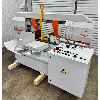
Solar Atmospheres of Western PA installed a new KASTO saw in its metallurgical laboratory to enhance capabilities for cutting advanced alloys like Inconel and titanium for metallographic evaluation and quality assurance testing.
Wynalda Packaging, a Michigan manufacturer of folding cartons and rigid boxes, launched a second shift following Labor Day 2026, now operating 24 hours daily. The expansion supports significant company growth and increased customer demand, with hiring underway for multiple production and support positions.
Dayton Rogers Manufacturing, a family-owned precision metal forming company founded in 1929, was featured on Bloomberg Television's World's Greatest program. The segment highlighted the company's engineering expertise and advanced manufacturing capabilities across its four U.S. facilities serving defense, aerospace, and medical industries.
Wilson Arms is expanding manufacturing capabilities and investing in new equipment under new private ownership. The Branford, Connecticut company manufactures barrels from .17 to .50 caliber and will exhibit at the 2027 SHOT Show Supplier Showcase.
Payroc, an official NSSF Affinity Partner, launched Easy Pay, an automated program helping firearms retailers manage recurring bills like rent, equipment leases, and mortgages by automatically withholding a percentage of daily card transactions. NSSF members can contact Laura Morgan for more information.
TS NCT, part of HEF Group, offers surface engineering solutions including Liquid Nitriding, PVD, and DLC coatings to enhance outdoor product performance by addressing wear, friction, and corrosion challenges.
Kowalski Heat Treating's K-Glow plasma nitriding process uses advanced technology and precise controls to improve wear resistance and component durability. The process creates hard, wear-resistant surfaces while maintaining dimensional stability, serving industries including automotive, firearms, and gear manufacturing.
Impac Systems Engineering partners with Reinforce3D to bring Continuous Fiber Injection Process (CFIP) technology to North American manufacturers. CFIP reinforces parts from the inside using continuous fibers, offering lightweight solutions for aerospace, automotive, UAV, and industrial applications while maintaining design freedom.
Layered Manufacturing and Consulting will exhibit at SHOT Show 2027, offering integrated additive and conventional manufacturing services including process development, design for manufacturing, and production-readiness support. The company maintains ITAR compliance and Federal Firearms License credentials for defense and firearms-industry programs.
When the Supplier Showcase first launched at the 2017 SHOT Show®, more than 260 material and service suppliers exhibited at the inaugural two-day event. This show-within-a-show drew positive reviews from exhibitors and attendees alike, as it allowed suppliers the opportunity to meet face-to-face with the manufacturing community, as well as retail buyers and gunsmiths looking to hone their business edge.
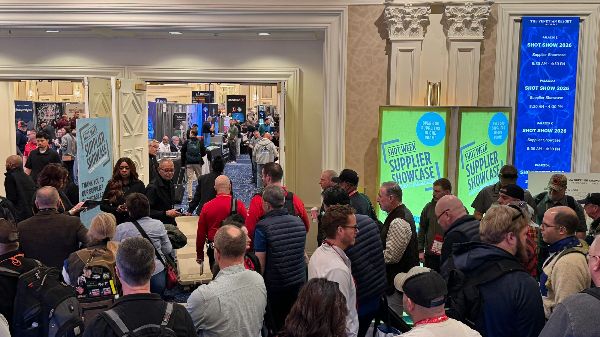
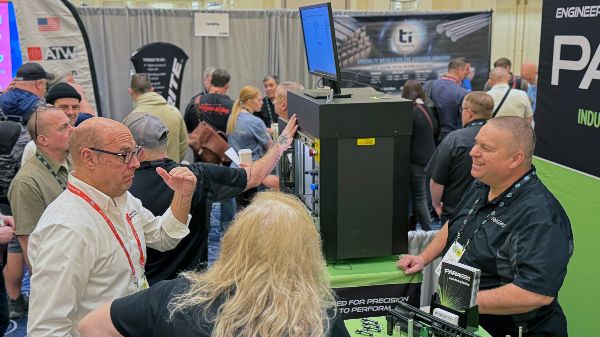
The size and scope of the Supplier Showcase have grown in the years since. At the most recent SHOT Show in January, over 600 suppliers exhibited at the Supplier Showcase. Packed aisles on the first morning of the showcase, which opens a day before the official opening of the SHOT Show, is one marker of its enduring business appeal.
A handful of suppliers shared why the Supplier Showcase has become a must-attend event that boosts their business far beyond SHOT Week®. Here are three reasons why it has become an essential component to long-term success for suppliers and buyers alike.
1. Direct Engagement With Decision-Makers
The Supplier Showcase, held on Level 5 of The Venetian Expo, attracts manufacturing companies and other buyers to peruse a wide spectrum of components and services — such as tools, machinery, plastics, fabrics, OE materials, logistics, software and more.
“This is the floor you want to be on if you’re a manufacturer — all these firearm companies need good machine shops,” said Mike Dowell, president of AXEM. “[We see] more quality over quantity, it’s excellent.”
In a similar vein, Jackson Spring & Mfg. Co. Inc. Director of Estimating and Design Patrick Kupczak emphasized the quality of connections they make as a Supplier Showcase exhibitor.
“We’ve noticed a lot more decision makers coming through here. We might not be getting as many leads, but they’re solid leads,” he said.
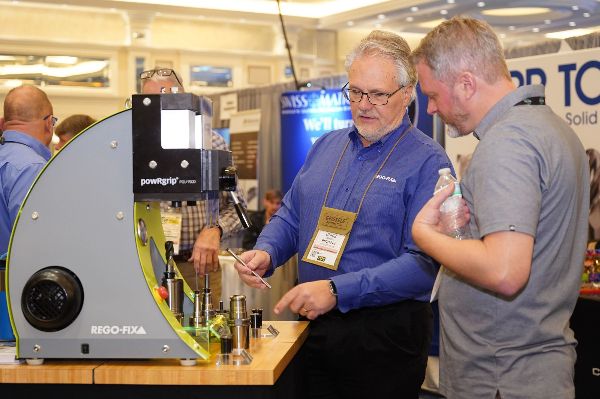
Shaun Ray, director of sales for Hydromat, is a five-time Supplier Showcase exhibitor. There’s a reason why his company exhibits year after year in this venue.
“We keep coming back because we always get some good leads and new customers,” he said. “You never know when that next shop is going come around that’s big enough to use some of our equipment, so it’s good to keep coming back.”
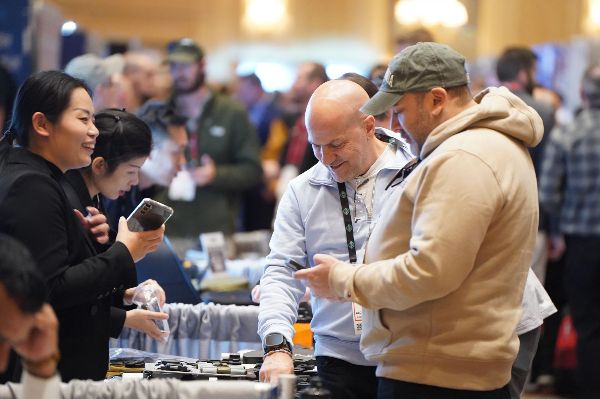
As noted earlier, the opening morning of the Supplier Showcase was a flurry of activity with interested buyers engaging with exhibitors. It was uncommon to see overflow conversations happening outside the booth — a trend that continued in the second day.
“It’s funny, for most shows the busy day is the first day while the last day is slow, but it’s not the case here. We expect to have even more interest,” observed David Allen, president of Square Stamping Mfg. Corp.
2. Year-Round Lead Generation
There’s no question: Face-to-face connections made during the Supplier Showcase generate year-round business opportunities.
“This is a business where you need to have strong relationships with key players, so being here at the Supplier Showcase is definitely one of the few moments where you can meet everybody,” said Ingo Pawlak, sales director, Electro Chemical Machining (ECM) for EMAG. “We’ve sold a couple machines and have been in deep negotiations thanks to being at SHOT Show directly — we’ve made great contacts here.”
After hearing about the inaugural Supplier Showcase from fellow suppliers after the 2017 show, Jackson Spring & Mfg. Co. Inc. has exhibited at every one since 2018.
“For us, people are buying products that we deal with. This is such a nice show that’s geared to what we sell,” said Jeff Kolozsy, plant superintendent for Jackson Spring & Mfg. Co. Inc. “People come to our booth, see what we offer and they know what they want. That’s why it’s such a strong show for us.”
Seeing the value of exhibiting at the Supplier Showcase as well as the main halls of The Venetian Expo during the SHOT Show, there are number of exhibitors that staff booths in both locations to meet with customers. One of them, Black Rain Ordnance, has exhibited in both venues for the past four years.
“Being a Supplier Showcase exhibitor has been quite good for us, we get a lot of hits each year — sometimes even three or four months after exhibiting we’ll get phone calls from contacts we made here,” said Mark Knight, Black Rain Ordnance Cerakote manager. “A lot of people don’t realize we’re a full-line manufacturer and we can tell them to stop by our booth and see everything we make.”
In addition to providing materials solutions, Supplier Showcase exhibitors offer software services to amplify firearm industry businesses. Ron Ketterling, president of Easy Bound Book, has exhibited at every Supplier Showcase since it was added to SHOT Week.
“Being here gives us a good opportunity to meet our clients, and repeat showings enhance our credibility with attendees,” he stated.
The Supplier Showcase has become a vital addition to SHOT Week, and it’s about to get even better. New for 2027, the opportunity for suppliers and solution providers to connect with manufacturers will expand to four days with Supplier Showcase Reloaded.
Thanks to overwhelming demand from suppliers and manufacturers, the Supplier Showcase will be open Wednesday and Thursday during SHOT Week for the first time. Monday and Tuesday, the Supplier Showcase will have the same format and setup as previous years. Wednesday and Thursday, Supplier Showcase Reloaded will unveil a refreshed floorplan. Some suppliers will stay, while new suppliers will move into The Venetian Expo Level 5.
“With the addition of Supplier Showcase Reloaded, there will now be an opportunity for more than 800 suppliers to meet directly with key decision-makers and buyers during SHOT Week,” said Melissa Schilling, NSSF Vice President, Exhibitions & Events. “For those Supplier Showcase exhibitors staying across all four days, the reloaded floorplan will create additional connections to make their presence even more valuable.”
For more information on the Supplier Showcase, visit shotshow.org/supplier-showcase. If you’re interested in becoming a Supplier Showcase Reloaded exhibitor, applications are available here.
The 2027 SHOT Show kicks off its four-day run Tuesday, Jan. 19, while the Supplier Showcase launches Monday, Jan. 20. Supplier Showcase Reloaded makes its SHOT Week debut Wednesday, Jan. 20.