
If you supply components, materials, machining, finishing or manufacturing technology to the firearms industry, you’re probably already aware that suppressors are having a moment.
Actually, “moment” doesn’t begin to describe it.
During a recent SilencerCo media event, company President Scott Clinger told industry media that suppressor sales have already hit 1 million units this year. And he expects the market to finish 2026 at roughly 2 million suppressors sold.
To put that into perspective, when SilencerCo entered the market in 2008 with its Sparrow rimfire suppressor, the entire country was processing roughly 11,000 Form 4s annually.
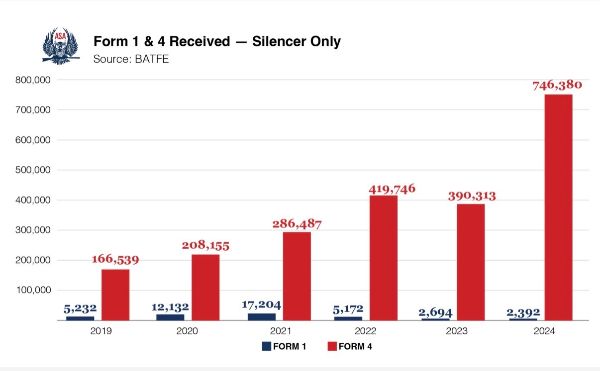
In 2024 and 2025, the American Suppressor Association (ASA) reported that ATF processed 746,380 and 732,863 silencer-only Form 4s, respectively. Now, in the first half of 2026 alone, ATF has processed more than 1 million approvals.
That kind of growth doesn’t just affect suppressor manufacturers. It ripples throughout the entire firearms supply chain.
Removing the Barriers
The suppressor market had already begun accelerating when ATF dramatically reduced eForm 4 processing times in 2024. Waits that once stretched for months—and sometimes close to a year—fell to days.
Then January 1, 2026 arrived and the $200 federal transfer tax effectively disappeared.
Two of the biggest objections consumers had to buying suppressors were suddenly gone.
The results were predictable. The regulatory outlook, however, became a little less predictable following the recent federal district court ruling in Jensen v. ATF. We should have a better understanding of the ruling’s impact come October 5, 2026. That’s the deadline for the U.S. Department of Justice to file an appeal or request a stay of the ruling.
Earlier this year, suppressor manufacturers were already reporting demand well beyond expectations. Yankee Hill Machine owner Chris Graham said his company sold one-third of its entire 2025 suppressor volume during the first quarter of 2026. Rugged Suppressors Marketing Director Callie Baldwin reported the company couldn’t keep its 9mm and .22 suppressors in stock, while Jaguar Silencers CEO Ben Staub projected his company’s branded suppressor sales could reach four times its 2025 volume.
Silencer Shop, meanwhile, described the first quarter as its biggest ever and said business was running roughly twice what it had expected based on the previous year.
And that was months ago.
Scaling Is the Challenge
For suppliers, the important story isn’t simply that consumers are buying more suppressors. It’s what suppressor manufacturers have to do to produce them.
During a recent QA Outdoors interview, SilencerCo Chief Marketing Officer Mike Aland identified the company’s ability to anticipate demand and then scale production to meet it as one of its strategic advantages.
But volume alone isn’t the objective.
“We could put out a lot of silencers, but putting out silencers that have the innovation and quality we expect becomes a little more tricky,” Aland explained.
That distinction matters to suppliers.
A market doubling in size doesn’t simply require twice as many finished suppressors. It requires more raw material, bar stock, tubing, forgings, machined components, cutting tools, fixtures, coatings and finishing capacity.
It also means more CNC machine time, laser welding, additive manufacturing, inspection equipment, packaging and logistics.
And, importantly, it requires all of those things without sacrificing quality.
SilencerCo, for example, performs destructive testing on every 300th suppressor by SKU. Aland said that testing previously uncovered a manufacturing issue early enough for the company to prevent thousands of potentially affected suppressors from reaching consumers.
When production volumes climb this quickly, quality-control systems have to scale right along with them.
The Opportunity Goes Beyond Suppressors
The impact also extends well beyond companies actually making cans.
Aland points to the growing number of traditional firearms manufacturers offering factory-threaded barrels as evidence that suppressors have moved toward the mainstream.
“Never before have there been more options for consumers to buy guns that they can throw a can on immediately,” he said. “But it’s just beginning.”
That means the suppressor boom is also a threaded-barrel boom. And a muzzle-device boom. And potentially a barrel-making, machining, tooling and accessory boom.
Then there’s product development.
Suppressor makers are competing across an increasingly broad range of designs incorporating titanium, additive manufacturing, low-back-pressure technology, lightweight hunting designs and modular systems.
Aland describes the market as divided between “do-all cans” and what SilencerCo calls “scalpels”—highly specialized suppressors engineered for particular applications.
Both categories create opportunities for suppliers capable of helping manufacturers improve designs, materials, processes and production efficiency.
Two Million Is a Lot of Cans
Nobody knows exactly where the suppressor market eventually settles. But 2026 is making one thing increasingly clear. Suppressors are no longer a niche accessory tucked away in one corner of the firearms industry.
If Clinger’s projection is correct and Americans purchase approximately 2 million suppressors this year, manufacturers are going to need an enormous amount of material, components, equipment and production capacity to feed that demand.
And consumers buying their first suppressor today may very well be buying their second and third tomorrow.
For suppliers looking for where the growth is in the firearms industry, you don’t have to look very hard.
Just follow the cans.
– Paul Erhardt, Managing Editor, the Outdoor Wire Digital Network
Also see:
SilencerCo, Boom Times, and What it Takes to Stay On Top
QA Outdoors Talks With Mike Aland, Chief Marketing Officer of the Syndicate Group
SAF and its Partners Hand the NFA its First Significant Defeat in Court